Children learn best when they are excited and engaged in learning which challenges them and shows them what they can do and stretches and excites their imagination. When there is joy in what they are doing, they learn to love learning. By offering every child – whatever their own individual characteristics – the chance to achieve their full potential we give them foundations for future learning, and for success in life.
Monday, September 12, 2011
Stick Patterns
You can use just about anything around the house to do this little activity, I love colored match sticks. You can pick these up from any discount store.
Master 3 happily made three different patterns using his sticks. Get your little one to say their pattern out loud as this helps them to understand the repeating factor involved.
Then I gave him a piece of black card and some PVA glue and he happily made these stick patterns.
Tuesday, August 23, 2011
Making Patterns
Monday, August 22, 2011
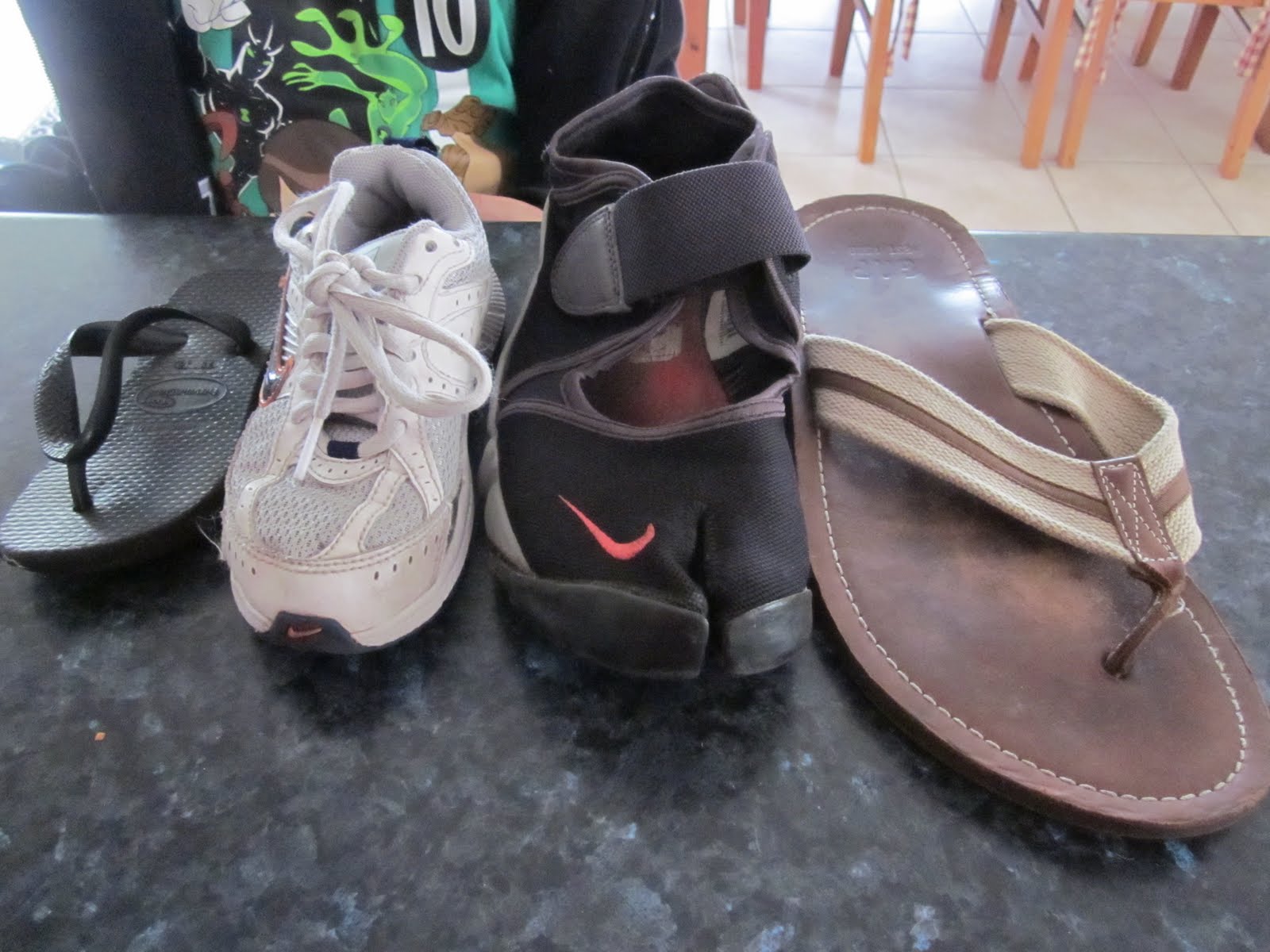
Who does the shoe fit?
This is a fun activity you can do when discussing the mathematical terms "biggest" and "smallest". It is also a great opportunity to use scissors as you cut around the traced shoes. Gather a shoe from each member of the family and use a pencil to trace around the them. Cut out the shoe shapes and order and then glue them on a large piece of paper.
Monday, May 2, 2011
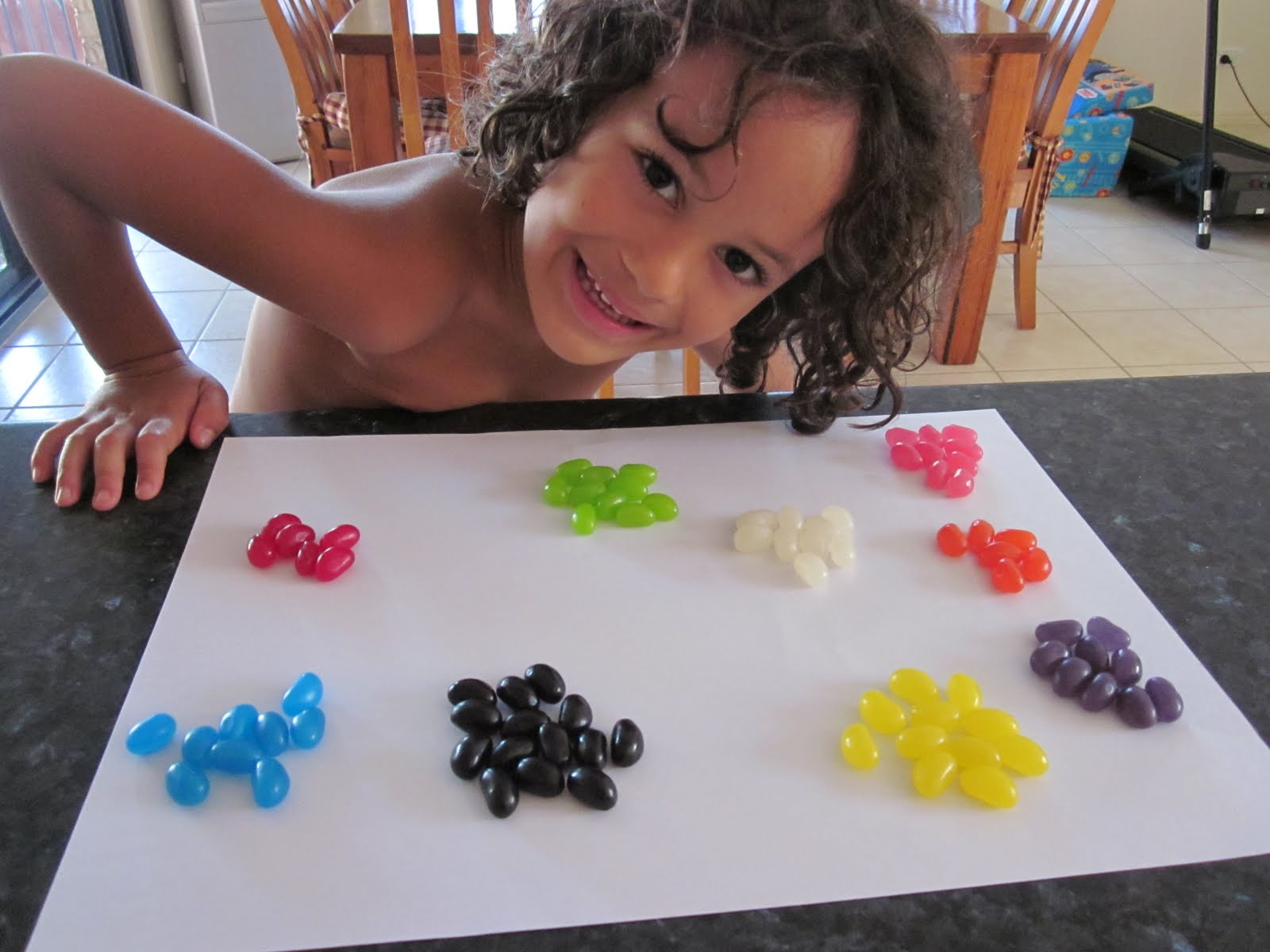
Jelly Bean Fun

I had great fun doing this activity with Master 4 as it gave him the opportunity to be able to estimate, count and create a graph using individual jelly beans. This is a favourite of mine that I have used many times when teaching. Children love "real" maths and what more can be real than getting to eat a few jelly beans at the end of your activity! The activity itself has many numeracy opportunities: counting, colour recognition, estimating, graphing, mathematical language development (more/less)
Introduce the term "estimate or guess" to your child. Get him/her to estimate how many there are of each colour before actually counting them.
Using the Jelly Bean graphing Template talk to you child about what a graph is and why we use them. Then colour the bottom row showing what coloured Jelly Beans you will be graphing. Then get your child to place the jelly beans on the graph one colour at a time. Explain that you can count the total number of each colour individually or you can read the number along the side (if they are at this stage).
Tuesday, February 8, 2011
Elmer The Elephant

Master 2 has a real fascination with animals, all animals in fact. So whenever I bring out a story to read that has an animal character in it, there are no limits in where I can take the learning to with him. A recent visit to the zoo and feeding of the elephants has sparked an interest in them, in particular the way they use their trunk to take the fruit from his hands. After reading our story he was very keen to help me put together a dress-up costume so we could re-enact the story together!
(So sorry but for some reason I can't turn this photo!)
The story of Elmer the Elephant is a comical fable that celebrates individuality and the power of laughter. This happy elephant brings hours of joy and laughter to our bedtime reading sessions. As Elmer is a patchwork elephant it is a great book to use when looking at colours and shapes, in particular squares. I'm having a bit of a shape week for Master 2, so I decided to do some fun craft with him after sharing the book together over morning tea. It is a very simple craft activity that only needs an outline of Elmer, coloured paper cut into squares and glue. It is a cute little activity that allows you time to sit and talk about colours and ask "What colour patch are you gluing on now?" It will give you an indication of what colours your little one is confident with and which ones you need to still work on.
Tuesday, September 28, 2010
Learning With Puzzles

We have been sick in our household for the last couple of days, so it was a perfect opportunity to bring out all our puzzles, get down on the floor and get busy. I find puzzles are an innovative way to learn certain skills, that are essential to toddlers before they enter school. The bright and attractive colours, and the uniquely shaped pieces, appeal to them, and are therefore useful and effective in ways that both, entertain and educate the little ones. Monday, September 27, 2010
Teaching About Shapes

- Snack Shapes - Cut bread into shapes and ask them to eat the shapes. You can create a mix of squares and triangles and ask your child to eat the squares first. Not only he or she will eat a lot of bread in this way, but will also learn to differentiate between a square and a triangle. For an added variation, cut cheese into shapes as well to make shape sandwiches.
- Shape BINGO -Use the printable BINGO cards below to play a friendly game of Shape BINGO with your preschooler. They will have fun, and learn at the same time.
Preschoolers only need to know about the basic shapes, such as squares, circles, triangles, etc. They will learn the more complex shapes in the later years of their education.
- SHAPE RUBBINGS - Try one or both of these ideas with your group.
On cardboard, draw shapes such as circles, squares, triangles, and rectangles. Squeeze glue from a bottle over the shape outlines and allow it to dry. Then let your children place pieces of paper on top of the shapes and color over them with the sides of crayons to make rubbings of the glue outlines.
Cut familiar shapes out of cardboard and attach them to a tabletop with double-sided tape. Have the children place their papers on top of the shapes and rub over them with crayons. - COOPERATIVE SHAPE COLLAGES - Draw a familiar shape, such as a circle, in the middle of a piece of butcher paper. Invite your children to look through magazines and tear or cut out pictures of circular shaped items. Then have them glue the pictures onto the butcher paper around the circle in the center. Let the children make collages for other familiar shapes to display together on a wall or a bulletin board.
- CREATING WITH SHAPES - From several colors of poster board, cut out assorted sizes of circles, squares, triangles, and rectangles. Store the shapes in a box or a zipper-top bag. Let your children take turns arranging the shapes on a tabletop or on the floor any way they wish to create pictures.
- TRACE AND MATCH SHAPE GAMES - Cut several familiar shapes out of cardboard to use for these games. Sit with your children in a circle and lay out the shapes in the middle. While the children close their eyes, trace around one of the shapes on a piece of paper. When the children open their eyes, have them guess which shape matches the traced one. Continue with the remaining shapes.
Using a marker, trace around each shape on a large piece of poster board. Let the children try matching the shapes by placing them on top of the tracings. - SHAPE LACING CARDS - Cut familiar shapes out of cardboard and punch holes around the edges. On each shape, tie one end of a long piece of yarn through one of the holes. Wrap tape around the other end of the yarn to form a lacing needle. Set out the shapes and invite your children to lace the yarn in and out of the holes (activity requires supervision).
- SHAPES, SHAPES, SHAPES Tune: “Three Blind Mice” Shapes, shapes, shapes; shapes, shapes, shapes.We love shapes, we love shapes.There’re squares and circles for me and you,Triangles, rectangles, ovals, too,Hearts and diamonds, to name a few.Yes, we love shapes.
- PUZZLES - bring out any puzzles that have shapes in them. Puzzles provide a great opportunity to talk about the properties of each shape.
DIAMONDS
FIND A DIAMOND Tune: “Clementine”
Find a diamond, find a diamond,
Find a diamond on the floor.
Put your finger on the diamond,
On the diamond on the floor.
Find a diamond, find a diamond,
Find a diamond on the floor.
Put your two feet on the diamond,
On the diamond on the floor.
- Bake diamond-shaped cookies for kites. Let your children decorate them with frosting and sprinkles and add licorice whips for kite strings.
- Use masking tape to make a large diamond shape on the floor. Have the children try tossing beanbags inside the shape.
- Show the children how to glue craft sticks onto paper in diamond shapes to make kites. Have them decorate their kites as desired and glue on pieces of string.
OVALS
WAVE YOUR OVAL IN THE AIR Tune: “If You’re Happy and You Know It”
Wave your oval in the air, in the air.
Wave your oval in the air,
Then wave it here and there.
Wave your oval in the air, in the air.
Wave your oval at your toe, at your toe.
Wave your oval at your toe,
Then wave it to and fro.
Wave your oval at your toe, at your toe.
- Oval Ladybugs: Make thumbprints on light colored paper with red paint. When dry, use fine point markers to add spots, legs, and a head to each print.
- Cut five ovals out of felt and use a marker to number them from 1 to 5. Set out a bowl containing 15 oval-shaped dried beans. Then, sitting with each of your children in turn, have them name the numerals on the ovals and place a matching number of beans on each one. (Note: Activities using small objects require close supervision.)
- Have the children help make burritos with oval black beans.
CIRCLES
LET'S GO ROUND THE HULA-HOOP Tune: "London Bridge"
Let's go round the Hula-Hoop,
Hula-Hoop, Hula-Hoop.
Let's go round the Hula-Hoop,
Round the circle.
Round and round and round we go,
Round we go, round we go.
Round and round and round we go,
Round the circle.
- Place a Hula-Hoop flat on the floor. Then invite your children to try such activities as these.
Walk, crawl, or tiptoe around the hoop.Toss beanbags inside the hoop. - Pizza: Cut a large circle out of orange felt for a cheesy pizza. Cut out smaller red circles for pepperoni, black circles for olives, brown circles for sausage, and green rings for peppers.
- Place folded paper towels in shallow containers and pour on tempera paint. Let your children make circle prints by pressing the ends of corks onto the paint, then onto paper. When the paint has dried, have the children use markers to turn their prints into pictures.
RECTANGLES
DO YOU KNOW THE RECTANGLE? Tune: "The Muffin Man"
Do you know the rectangle, (Hold up a rectangle.)
The rectangle, the rectangle?
Do you know the rectangle?
It has four sides like this. (Point to four sides.)
Two are long and two are short, (Point to long sides, then short sides.)
Two are short, two are short.
Two are long and two are short.
It has four sides like this. (Point to four sides.)
- Have your children draw pictures on rectangular pieces of construction paper, encouraging them to fill up the space as much as possible. Then cut each child's paper into several rectangular puzzle pieces and challenge the child to put his or her puzzle back together.
- Collect rectangular sponges and pour tempera paint into shallow containers. Invite your children to dip the sponges into the paint and press them onto a rectangular piece of butcher paper to make a print mural.
HEARTS
RED HEARTS, RED HEARTS Tune: "Twinkle, Twinkle, Little Star"
Red hearts, red hearts here and there,
Red hearts, red hearts everywhere.
All the hearts are here to say
Let's be special friends today.
Red hearts, red hearts here and there,
Red hearts, red hearts everywhere.
- Bake heart-shaped cookies to decorate with frosting and sprinkles.
- Make stencils by using a craft knife to cut heart-shaped holes out of cardboard squares. Tape the stencils on top of white paper and let your children sponge-paint over them to fill in the holes. When the paint has dried, remove the stencils to reveal the sponge-painted hearts.
TRIANGLES
TRIANGLES, TRIANGLES Tune: "Jingle Bells"
Triangles, triangles,
Triangles I see.
Count the points and count the sides,
Count them 1, 2, 3.
Triangles, triangles,
Just for you and me.
Count the points and count the sides,
Count them 1, 2, 3.
- Ice Cream Cones: Glue brown triangle cone shapes onto paper. Add colorful paper circles for scoops of ice cream.
- Let your children make collages using triangles cut from fabric scraps
SQUARES
I'M A SHAPE THAT HAS FOUR SIDES Tune: "Mary Had a Little Lamb"
I'm a shape that has four sides,
Has four sides, has four sides.
I'm a shape that has four sides,
And they are all the same.
Count my points, I have four too,
Have four too, have four too.
Count my points, I have four too.
And Square is my name.
- Mosaics: Cut 1-inch squares out of bright coloured paper. Let the children glue the squares in designs on black paper.
- Picture Frames: Show the children how to glue four jumbo craft sticks together to make a square frame. Have them decorate their frames with such items as stickers, beads, or seeds.
Tuesday, August 24, 2010
Pegging Colours to make Patterns

This morning the boys and I spent some time focussing on colour recognition and patterning. If you are just introducing patterning use a simple AB pattern based on colour .Using everyday objects are a great way to reinforce patterning at home. (cars and trains are a favourite in our house!) I'm always looking for creative activities with a dual purpose - that suits a 4 year old and a 2 year old!! The boys had a great time this morning working through these simple cards that I made last night. I had some smiley face stickers in the craft box and used them to create AB and ABC patterns for Master4, and then put a smiley face of each colour for Master2 in different variations. I was looking for Master 2 to identify colours and use his fine-motor skills with the pegging onto the card. This is a really easy activity to make for your little one at home and you will find once you have spent time showing him how to do it, he will happily sit and complete the cards independently.
Easy Ways to Teach Numbers, Counting & Maths

Though preschoolers generally don’t recognise it, maths is another way to understand and make sense of the world, much like language. Like words, maths is used everywhere and is an integral part of everyday life. What exactly is maths? Simply put, maths is the observation, identification, description and explanation of numbers, space, relation, and order. Counting, measuring, problem solving, reasoning, and identifying shapes and patterns are the activities of math. Preschoolers, who have opportunities to learn maths through play and everyday interactions are gaining the foundation for maths development.
Beyond exposing young kids to maths, fostering a healthy attitude is key. A maths attitude includes observing that maths is all around, identifying maths as fun and interesting, and believing that maths is something you can do. When a child notices that mittens make a pair, observes the similar shape of stop signs, or delights in counting animal crackers, this child is not only doing maths, but also showing a healthy math attitude.
The best way to teach preschool children (or students of any age) is in a purposeful manner—in a context that has a purpose to the child. Teaching moments can be created by playing a game that involves mathematics (e.g. recognizing the number of dots on a die or a domino). Everyday activities provide a wealth of real learning opportunities. Basically, as parents we need to find or manufacture situations that create a real need on the part of the child to use, and thus learn or practice math. Below I have listed some ideas for you to use at home. You will probably recognise many of these that you already do on a regular basis without even intentionally teaching to your child!
Count everythingAs you go up steps, eat strawberries, pick flowers, put up Lego's, you name it.
Count to 60 while brushing their teeth
Master 4 and I take turns brushing his teeth and I count out loud to 60 for each of our turns. It's an easy way for him to understand the concept of one minute and he's picked up most of his higher numbers too.
Use Card Games
From UNO to Go Fish, these are fun and easy ways to get to know numbers and their relation to each other.
Cook Together
Include your child when you cook. Have him count the cups of milk, the tablespoons of margarine, or the eggs when you cook. Show him the recipe as you cook so he can follow along.
Build a Playhouse
All kids love to take part in building forts and playhouses. A nice side effect is that they'll painlessly pick up geometry while using measurements & angles. On a smaller scale, plan and build a Lego fort.
Give Them Puzzles
Young children learn valuable spacial lessons while putting together puzzles of all types. Tangrams (geometric shapes that can be put together to create pictures and new shapes) are also great tools.
Let Them Earn Some Money
Even tiny tots can do small jobs and earn some pocket money. pay the money with different denominations of coins each week so your child starts to identify coins and their value.
Use Math Games
There are so many great board games that incorporate maths concepts.
Do Connect the Dots
Paint by number, connect the dots and other "funbook" type sheets are great ways to learn early concepts while having fun.
Play Dice Games
Kids can roll the dice & add the numbers, play "horses" or make up lots of games on their own.
Sing Songs & Memorise rhymes
Everything from "10 Green Bottles sitting on the wall" to "5 Little Monkeys Jumping on the Bed" teaches counting down and subtraction. Many jump rope songs involve numbers too, and kinesthetic learners (those who learn best while doing and moving) and auditory learners (those who learn best by hearing and saying things) will especially benefit from moving and singing while they learn.
Count items around the house
Gather up items around your house such as buttons, pencils, paper clips, etc. Put them in stacks and count them with your child
Play Hopscotch
Use chalk and draw a hopscotch game outside. Make sure to say the numbers out loud as you play.
Read counting books
Check out counting books from the library. Read counting books to your child. Have him practice counting as you read the book.
Have a treasure hunt
Fold up ten pieces of paper. On each piece of paper draw a number of items. For example, draw one fish, two triangles, or three apples. Also write a clue on the paper telling where to find the next number "clue". Start the game with number one and end with the number ten. Have your child count the items on the page before you read the clue.
Play a telephone game
Using a toy telephone and a telephone book, have your child call an order a pizza. Help him read the number and press the numbers on the phone. You can also call the florist and have flowers delivered. Let your child use his imagination.
Make a counting book
You can purchase a blank book at an educational supply store or make your own with construction paper and a three-hole punch. On each page have your child draw or trace a number. Have him draw items such as balls, worms, or smiley faces to correspond with the number. Make pages for one to ten or one to twenty if your child is older.
Play an "I spy" game
Take turns playing "I spy". Look around your room and say, "I spy something we have two of (or three of)..." It could be speakers for your stereo, cushions on the couch or pictures on the wall, or anything you can count.
Some of my favourite books to use when I'm teaching about numbers and counting are:
- Hungry Monsters Teach Counting in Rhyme by Susan Heyboer O’Keefe and illustrated by Lynn Munsinger.
- Young Children Can Learn to Count Down From Ten With Ten Little Ladybugs written by Melanie Gerth and illustrated by Laura Huliska-Beith
- Miss Spider’s Tea Party Teaches Counting With a Social Lesson written and illustrated by David Kirk.
- Six Dinner Sid by Inga Moore
- The Bad-tempered Ladybird Eric Carle, a good story to discuss the concept of size with a young child. This book would also be excellent for consolidating a child's understanding of time, as at the top of each page it shows a clock face with the time that the bad-tempered ladybird meets each animal.
- The Very Hungry Caterpillar
- The Shopping Basket by John Burningham
- Nine Ducks Nine by Sarah Hayes
- Handa's Surprise by Eileen Browne
- The Smartest Giant in Town by Julia Donaldson
- One is a Snail, Ten is a Crab by April Pulley Sayre
Monday, July 19, 2010
Maths Through Play
Maths through Play
To many adults, the words Maths and Play have absolutely nothing to do with each other. For many of us, maths was a torture, something we had to do, and something we didn’t understand and couldn’t do. Play on the other hand was something we loved. Young children are learning maths all the time through a wide variety of play experiences. From the time they are born, babies are surrounded by sense impressions. Shapes in particular are of
immediate importance: babies react instinctively to the arrangement of shapes which make up the human face. In the home, in parent and toddler groups, and pre-school settings, children have many opportunities to enjoy and learn Maths through Play. “Play is an effective vehicle for fostering Mathematical concepts and developing positive attitudes to mathematics.
Maths in the Home
Maths is everywhere in the home. With the support of parents, children can grasp many mathematical concepts through their play.
Children will begin to:
• know and understand early maths language of measurement, shapes, spaces,
positions, early numbers, order and patterns
• know the sequence of numbers
• begin to understand positional words, e.g. in, on, outside
• show an awareness of time
• be aware of shapes in their environment
• be aware of 1-to-1 correspondence
• acquire new vocabulary
• learn number rhymes and songs, e.g. one, two, buckle my shoe etc.
• be aware of conservation
When we say a child “knows her numbers” what we often mean is that she can recite the names of numbers in ascending order. This is quite useful to be able to do, but it means very little in itself. Children need to come to know what the number system really means. They can be helped to do this through play. One of the first things they have to learn is about conservation – that 3 is always 3 no matter how it is arranged or presented, whether it is the number 3, the letters for three, 3 bricks, 3 buttons on a coat or 3 Billy Goats Gruff.
Before a child can understand numbers for things that can be seen – 3 miles, 3 years old – s/he needs real objects which can be seen and handled with a chance to check that the count is right each time. Young children have many mathematical experiences in their home environment.
For example:
• they learn about money as they go shopping with parents
• become aware of numbers as they count the stairs to bed
• start to understand the concept of time as they become familiar
with the routine of their day– wash, dress, breakfast etc.
A child’s daily life offers many practical opportunities to learn about
number, shape, space, sorting and matching. For instance:
• setting places at the table – a cup for me, a cup for you
• playing with water
• steering the pram
• helping to sort the washing, matching socks, big shirt/small shirt
• tidying up – putting similar items together
• matching lids to saucepans
Here are a few ways in which you can use play to learn mathematical concepts.
Sand and Water
• Using sand can develop mathematical concepts and language,
e.g. heavy, light, empty, full, big, and little
• Conservation – how much will it hold
• Make shapes and patterns
• Provide boxes and materials of different shapes and sizes to compare weight and quantity
• Look at the differences between wet and dry as a means of looking at weights
Language
• You can help to promote mathematical language such as – heavy, light,
empty, full, long, short, big, small in relevant contexts
• Look at your home environment to develop language, especially positional words
– small object in front of big object, behind, in, on
Dough
The use of dough can help to develop a mathematical understanding for pre-school children.
• Develops mathematical language – short, long, fat, thin
• Make shapes of different dimensions – flat shapes,3-d shapes
• Create opportunities to compare things that float with things that do not
Imaginative Play
• Simple activities like letting your child set the table for dinner can help develop counting
skills,e.g. getting out three pieces of cutlery.
• Involve your child with household activities. After washing, allow your child to sort clothes
into different colours, or different types of clothes, e.g. t-shirts and socks.
This will help to develop a child’s knowledge of shapes and colours.
Books and Rhymes
Enjoy stories and rhymes with your child that has a mathematical element, e.g. “One-two, Buckle my Shoe” This can also help to develop literacy skills by showing your child that the print reads from left to right. Let your child count out items in the books – how many animals are on the page, how many items are blue. Using rhymes can also help develop your Child's awareness of sequencing.
Physical Play
• Develop fine motor skills through physical activity, e.g. Sorting out a jigsaw,
threading beads
• Block play or playing with toy cars can help to develop sequencing by encouraging your child
to sequence according to size, colour, use (e.g. bike, car, and truck)
• Playing with different sized blocks can help to develop an understanding of weight and
dimensions.
• Tidying toys away allows children to sort into different sizes and colours.
• It can also develop mathematical language – first, second, third, how many are blue, which
is largest / smallest.
Nature
By planting seeds you can help to develop your child’s understanding of time and the life cycle of plants. Watch as the plants grow and even measure your plant – develop language such as taller. Teach your child about the different times of the year to compare colours, flowers, smells.
Monday, June 28, 2010
Tap into your kids creativity with number dancing!

Saturday, June 26, 2010
I Spy with my Little Eye...


- Shape Bottles
- Number Bottles
- You could make a bottle that has laminated pictures from a story you have read, children identify main characters in the story.